

Perforated leather seats look and feel premium, until crumbs, dirt, and spilled coffee find their way into those tiny holes. Learning how to clean perforated leather seats correctly matters because the wrong technique or product can push debris deeper, clog the ventilation perforations, and even cause moisture damage beneath the surface.
At My Detail Buddy, we detail perforated leather interiors across the Waxhaw and Charlotte area every week. It’s one of the services our clients ask about most because these seats demand a different approach than standard leather care. The holes change everything, from the products you use to how you apply them. We’ve put together this guide based on what actually works in our hands-on experience, so you can maintain your seats between professional details.
Below, you’ll find a clear, step-by-step process for removing dirt and spills from perforated leather without causing damage. We’ll cover the right tools, safe cleaning solutions, and the specific mistakes that ruin seats, plus when it’s worth calling in a pro for deep cleaning or stain removal you can’t handle at home.
What makes perforated leather seats tricky
Standard leather seats have a smooth, closed surface you can wipe clean in a few passes. Perforated seats have hundreds of tiny holes punched through the leather, and each one acts as a collection point for fine dust, crumbs, skin cells, and liquid. When you wipe the surface with a cloth, you push debris straight into the perforations rather than lifting it away. That’s the core challenge when figuring out how to clean perforated leather seats correctly.
The holes trap debris you can’t see
Each perforation is small, but together they cover a large portion of your seat. Dry debris compacts inside the holes over time, making it harder to extract without the right tools. A standard cloth forces material deeper rather than lifting it out, meaning buildup accumulates under the leather’s surface layer where normal cleaning won’t reach.
Common materials that get trapped in seat perforations:
- Fine sand and road dust
- Pet hair and dander
- Food crumbs and sugar residue
- Skin cells and body oils
Moisture is the hidden threat
Over-wetting perforated leather is one of the most common mistakes people make. When you apply too much cleaner or water, it seeps through the holes and soaks directly into the seat backing and foam padding below.
Liquid sitting against the foam under your seat dries slowly from the inside, creating the conditions for mold, mildew, and persistent odor.
That trapped moisture has no quick escape route, and the result is a seat that smells bad and may develop foam breakdown underneath the leather that no amount of surface cleaning will fix.
Step 1. Gather the right tools and prep the seat
Starting with the right equipment makes every part of how to clean perforated leather seats easier and safer. Using the wrong brush or cloth can force debris deeper into the holes, so pulling together your tools before you start saves time and protects the leather.
Using the correct tools from the start prevents the most common mistakes that lead to damaged leather and clogged perforations.
What to gather before you start
Lay everything out before you touch the seat. You need a soft-bristle detailing brush, a vacuum with a narrow crevice tool, a pH-neutral leather cleaner, and a few clean microfiber cloths. Avoid sponges and terry cloth towels; both push debris into the holes rather than lifting it out.
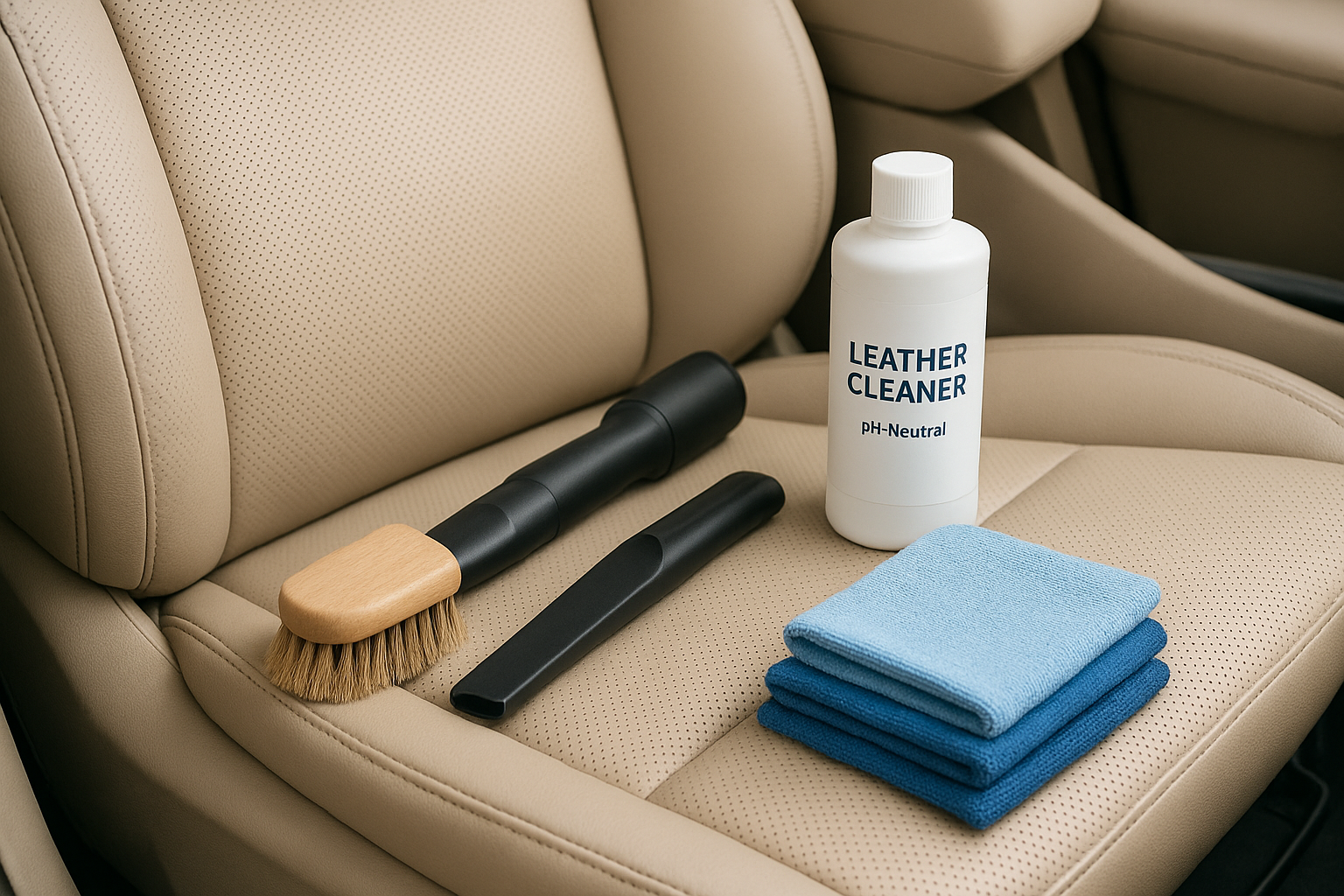
- Soft-bristle detailing brush (natural bristles preferred)
- Vacuum with crevice attachment
- pH-neutral leather cleaner
- Microfiber cloths (multiple)
- Compressed air canister (optional but helpful)
Move the seat back to give yourself full access to the seat bottom, and adjust the headrest position if it blocks your reach to the upper cushion.
Step 2. Remove dry dirt from the holes safely
Removing dry debris is the first active cleaning step, and the order you follow here determines how much dirt you actually extract versus push deeper into the holes. When figuring out how to clean perforated leather seats, always tackle dry debris before applying any moisture to the surface.
Applying liquid before removing dry debris turns fine dust and crumbs into a paste that clogs perforations and is far harder to extract.
Use compressed air to loosen trapped debris
A short burst of compressed air directed across the seat surface, not straight down into the holes, forces loose particles up and out of the perforations. Hold the canister at a low angle of about 30 degrees and work in short bursts across one section at a time. Follow immediately with your vacuum’s crevice tool to catch everything that dislodges.
Brush before you vacuum
Work your soft-bristle detailing brush in small, circular motions to loosen compacted debris from each perforation. Then run the vacuum crevice tool slowly over the same area to pull the loosened particles off the surface cleanly without forcing anything back in.
Step 3. Deep clean the surface without over-wetting
Once the dry debris is cleared, you can apply your cleaner. The critical rule when learning how to clean perforated leather seats is controlling how much moisture you introduce. Apply your pH-neutral leather cleaner to a microfiber cloth first, never directly onto the seat surface. You want the cloth slightly damp, not wet enough to drip when you press it.
Less product does more work here: a lightly loaded cloth cleans effectively without pushing liquid through the perforations into the seat foam below.
Work in small sections
Clean one small area at a time, roughly 6 inches square. Use your soft-bristle detailing brush to work the cleaner across the surface in gentle circular motions, then immediately wipe with a dry microfiber cloth to pull the loosened residue away. Repeat this process across the full seat, never letting any cleaner sit for more than 30 seconds.
- Apply cleaner to the cloth, not directly to the seat
- Work in 6-inch sections only
- Brush gently, then wipe immediately
- Never let product sit longer than 30 seconds
Step 4. Handle spills and odors in perforations
When a spill happens, your reaction time determines the outcome. Blot the affected area immediately with a dry microfiber cloth, pressing firmly without rubbing. Rubbing spreads the liquid across more perforations and forces it deeper into the seat foam below. This is the most critical step when learning how to clean perforated leather seats after a liquid incident.
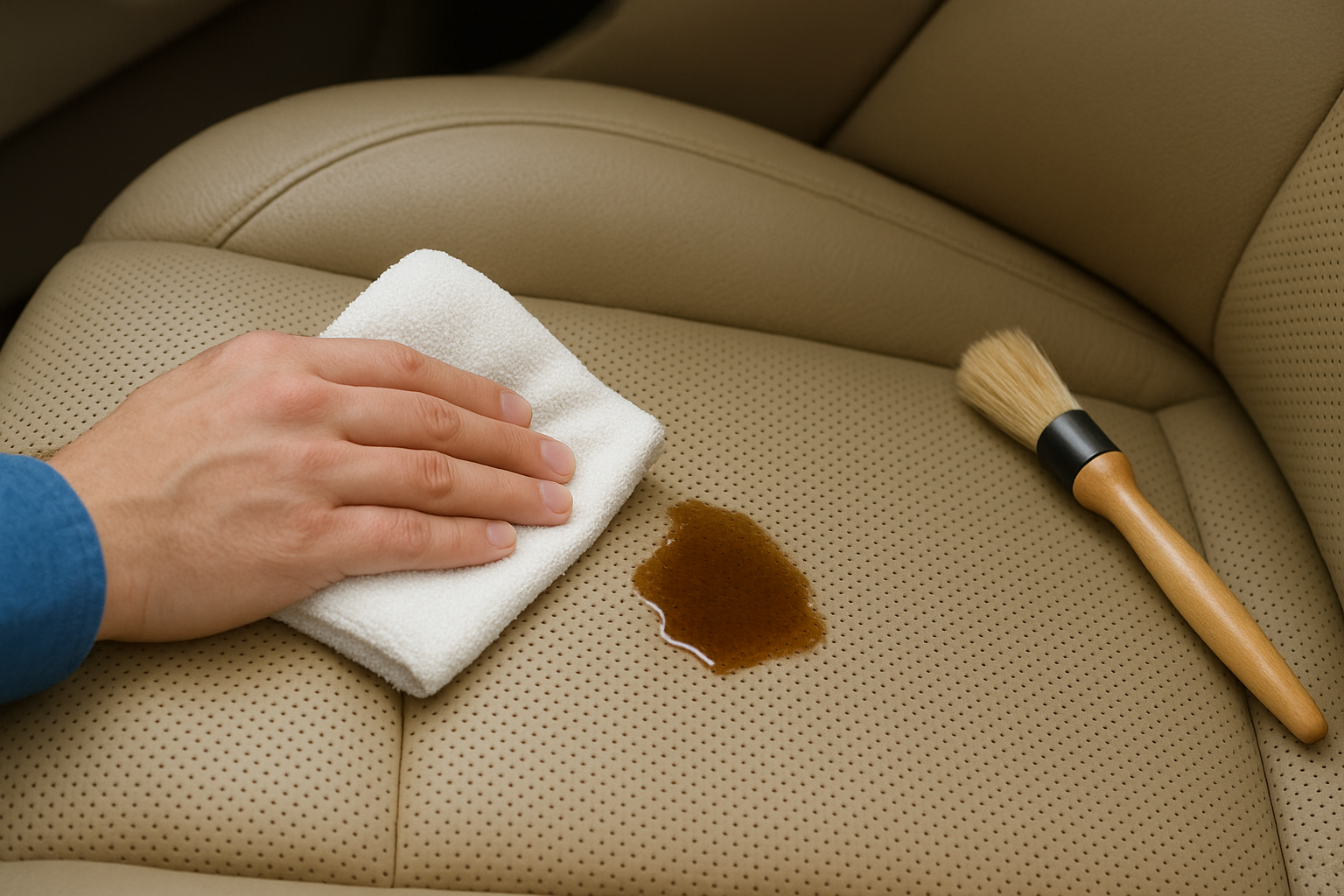
Acting within the first 60 seconds of a spill prevents liquid from soaking through the perforations into the seat padding where it causes mold and odor.
Treating odors trapped in the holes
Odors linger in perforations because bacteria and residue settle deep inside the holes where surface cleaning never reaches. Mix a solution of equal parts distilled white vinegar and distilled water, apply it lightly to a microfiber cloth, and work it across the seat with your detailing brush. Let the seat air dry fully with the car door open before using it again.
- Blot spills immediately, never rub
- Use diluted white vinegar to address odor-causing bacteria
- Allow complete air drying before closing the car
Step 5. Dry, protect, and prevent future buildup
After cleaning, drying the seat completely is non-negotiable when working through how to clean perforated leather seats. Leave the car door open and allow at least 30 minutes of air drying before sitting on the seat. Skip the heat gun and hair dryer; concentrated heat dries out the leather and causes cracking along the perforation edges.
Skipping the drying step traps residual moisture inside the perforations and recreates the exact conditions you were trying to remove.
Apply a leather conditioner
Once the seat is fully dry, apply a thin layer of leather conditioner to a clean microfiber cloth and work it evenly across the surface. Conditioner restores the oils that cleaning removes and keeps the leather supple around each perforation, which prevents cracking over time. Avoid spraying conditioner directly onto the seat.
Prevent future buildup
Consistent routine maintenance stops debris from compacting inside the holes between full cleans. Small habits protect the leather far more effectively than occasional deep cleaning sessions.
- Vacuum perforated seats every two weeks
- Blot any spill within 60 seconds
- Reapply conditioner every three months
Quick recap and next steps
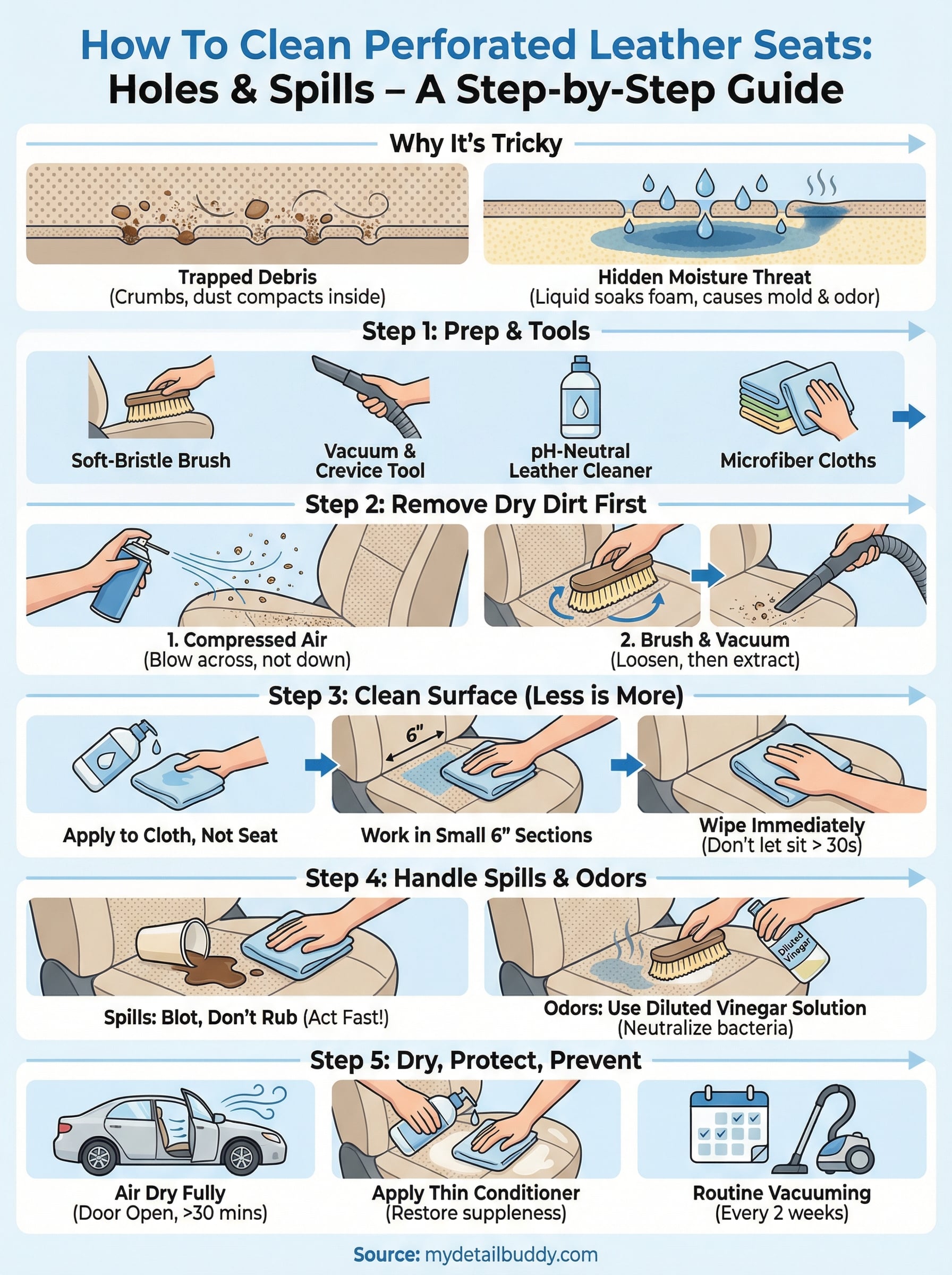
Knowing how to clean perforated leather seats comes down to following the right sequence: remove dry debris first, apply minimal moisture, blot spills immediately, and always let the seat dry completely before sealing it with conditioner. Skipping any one of these steps creates the exact problems you were trying to prevent, whether that’s clogged holes, trapped moisture, or cracked leather around the perforations.
Consistent maintenance is what keeps your seats looking clean between each full detail. Vacuuming every two weeks and conditioning every three months handles most of what daily use throws at perforated leather, so you rarely need to do a deep clean from scratch.
If your seats have staining, odor, or buildup that regular home cleaning won’t shift, a professional detail will get them back to where they should be. Check out our interior detailing packages and pricing to see what fits your vehicle and budget.


